
How Huawei inspired its audience to embrace a healthier lifestyle ?
From passive scrolling to active participation

Strategy
Context & Historical Landscape
The Shocking background we started from:
In Bulgaria, health and lifestyle are increasingly discussed, but not necessarily practiced.
The country faces a growing lifestyle and health problem that goes beyond individual habits and has become a societal issue. According to data from the National Center of Public Health and Analyses, 33.2% of Bulgaria’s adult population suffers from obesity.
The problem starts early. Research by the National Center of Public Health and Analyses shows that 32% of first-grade children are overweight, 15% suffer from obesity, and 20.4% have central obesity, which is associated with serious long-term health risks.
But obesity is not only a physical health issue. Studies link it to low self-esteem, reduced self-confidence, and increased risk of depressive conditions.
In many cases, the problem does not start with adults.
It starts with habits formed in the family — eating, movement, and daily lifestyle choices.
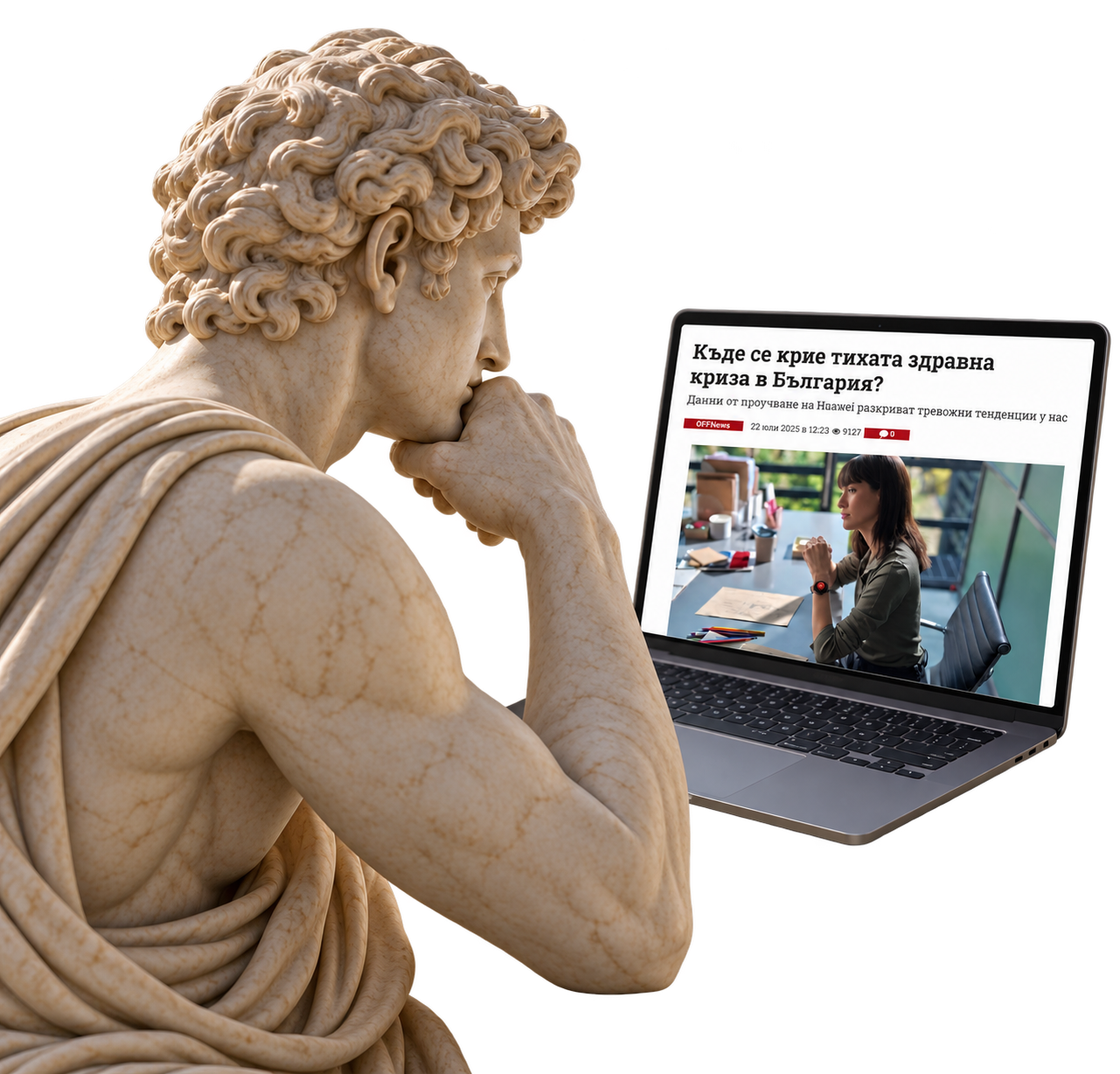
Which means the real problem is not just obesity.
The real problem is lifestyle.
And lifestyle is built through habits.
33.2%
of Bulgaria’s adult population
suffers from obesity
of Bulgaria’s adult population suffers from obesity
32%
of first-grade children are overweight
of first grade children are overweight
15%
suffer from obesity
suffer from obesity
20.4%
have central obesity
In a market saturated with product-led communication, attention is no longer won by features. It is earned through relevance.
In Bulgaria, Huawei holds a leading position in wearables, yet faces a structural communication challenge: Long gaps between major product campaigns, limited media investment, and strict regulatory boundaries that prevent positioning smartwatches as medical devices.
At the same time, the local cultural context presents another barrier – Bulgaria is not widely perceived as a health-driven or sports-oriented nation.
Yet beneath this perception lies a contradiction.
People care about health.
They think about it.
They talk about it.
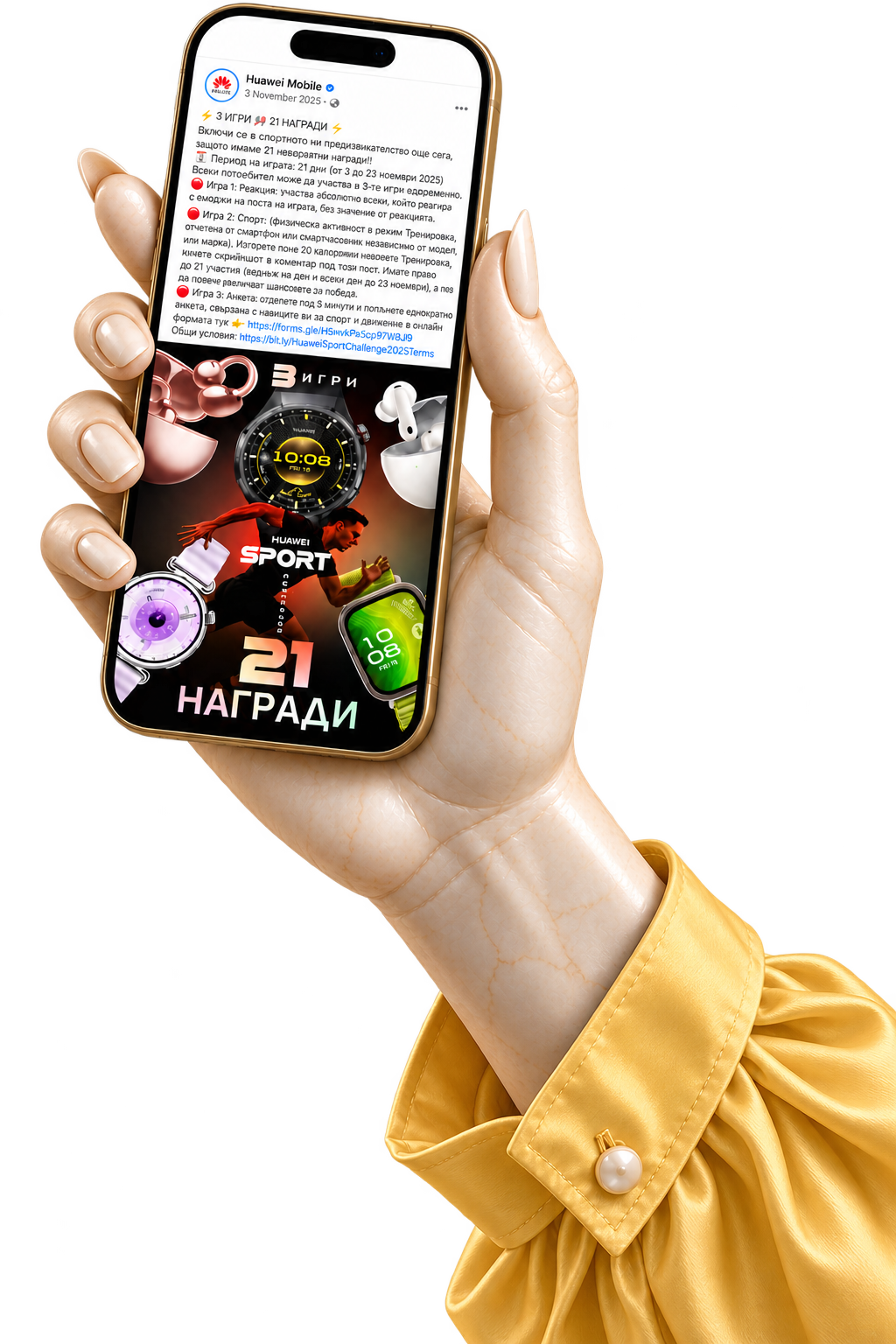
But they don’t act on it consistently.
For Huawei, this revealed a powerful strategic opportunity:
Not to tell people how to live healthier lives – but to involve them in discovering it themselves.
For Huawei, this revealed a powerful strategic opportunity:
Not to tell people how to live healthier lives – but to involve them in discovering it themselves.
For Huawei, this revealed a powerful strategic opportunity:
Not to tell people how to live healthier lives – but to involve them in discovering it themselves.
Strategic Business & Marketing Challenge
Traditional campaigns rely on telling.
They communicate features. They promote benefits. They push messages.
But in categories like health and lifestyle, telling is not enough.
Because behavior doesn’t change through communication. It changes through participation.
For Huawei, this created a fundamental challenge:
How do you move from product communication to behavior activation?
How do you engage people in health and sports without positioning your product as a medical device?
How do you build meaningful engagement in a low-budget environment?
At the same time, there was another limitation – the brand could not rely on global narratives around health data and medical positioning.
It had to create local relevance, local insights, and local stories.
The challenge was not just to communicate.
The challenge was to keep people engaged long enough to build a habit.
Target
Audience
Objectives
The campaign addressed a broad but insight-rich audience:
- Urban, digitally active consumers (25–54)
- Health-conscious individuals at different stages of their journey
- Casual users open to self-improvement
- Existing Huawei users and brand advocates
- Social media users motivated by interaction and recognition
Primary Objective:
Drive meaningful user engagement through participation-led communication.
Secondary Objectives:
Maintain an always-on brand presence between campaigns
Generate local insights to support communication and PR storytelling
Strengthen Huawei’s positioning in the healthy lifestyle
Integrate product features into real-life narratives
Tertiary Objective:
Drive product relevance and consideration through real-life use cases
Create scalable communication model across markets
Strategic
Idea
Approach & Measurement Framework
Ask. Engage. Learn. Amplify.
We transformed communication into participation.
Instead of starting with messaging, we started with questions.
Instead of pushing campaigns, we built conversations.
Instead of telling people how to live better, we invited them to show us how they live.
The audience behavior became the content.
And their input shaped the communication.
We designed a dual-phase activation model built around behavior and insight generation:
- Open conversations (qualitative surveys)
- Action-based challenges (steps, workouts)
- Structured surveys (quantitative insights)
- Incentivized participation (gamification & rewards)
Success was measured through:
- Participation volume
- Engagement depth (comments, shares, actions)
- Data collected (qualitative + quantitative)
- Cross-channel amplification
- PR visibility driven by insights
Channels
The campaign was built around a key behavioral shift:
People don’t just consume content. They participate in it.
We focused on an integrated, three-layer ecosystem:
Social Media (Facebook) → engagement engine
KOLs (Instagram) → credibility & reach
Survey (Google forms) → insight generation & data collection
PR → amplification & authority
Each channel had a distinct role, but worked in synergy.
Bulgaria, Sofia 1113,
5, Nikolay Ostrovski str.
+359 2 465 11 75
office@welldone.bg

